What Do Cavities Look Like? Signs You Shouldn’t Ignore
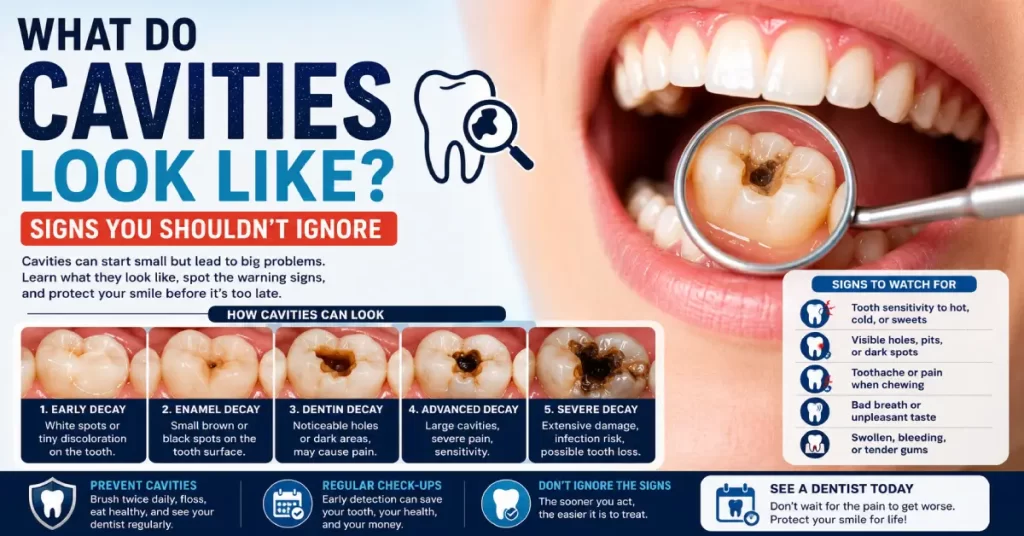
what do cavities look like
What Do Cavities Look Like? Signs You Shouldn’t Ignore
You catch a weird spot on a tooth in the mirror and immediately start wondering: is that just staining, or something worse? That’s usually the exact moment someone types what do cavities look like into their phone at midnight. Fair question. Cavities don’t behave the way most people picture them — some barely show at all, others you’d notice from across the room.
I’ll walk through the real answer, stage by stage. A faint white patch that’s easy to write off at first. A dark hole you’ll actually feel with your tongue before you ever spot it in a mirror. Along the way, how to tell a cavity apart from plain old staining, when a tiny spot is genuinely worth a dentist visit, and what people tend to miss when they’re checking their own mouths at home.
Early on, it’s usually a small white or chalky patch, near the gumline or tucked into the grooves of a back tooth. Easy to miss. It doesn’t hurt yet, and from a few feet away it just reads as a faint discoloration, nothing worth a second glance. That white-spot stage happens to be the best window to catch it, honestly, because the enamel’s only just starting to lose minerals here — nowhere close to actually breaking down. A lot of people figure a white spot’s harmless simply because it isn’t dark or painful yet. Give it time, though, and it usually keeps drifting toward visible decay.
Past that early stage, the color starts to shift. White turns yellow, yellow turns light brown, and eventually you’re looking at dark brown or black as more of the tooth structure gives way underneath, out of sight from anyone glancing in a mirror. Texture follows right along with it. A tooth that used to feel smooth under your tongue starts feeling rough, sometimes pitted where decay’s actively working away. Some cavities go as far as forming a visible dent you can catch in decent lighting, molars especially, since that’s where food tends to sit the longest without anyone noticing.
Color and texture shift enough at each stage that seeing them laid out helps more than another paragraph would.
| Stage | Color | Texture | Pain Level |
|---|---|---|---|
| Early demineralization | White or chalky | Smooth | None |
| Enamel decay | Light brown or yellow | Slightly rough | Mild sensitivity |
| Dentin decay | Brown | Rough, possible pit | Noticeable pain |
| Advanced decay | Dark brown or black | Visible hole | Sharp or constant pain |
| Abscess forming | Dark with swelling nearby | Soft or crumbly | Severe, throbbing |
Checking Your Own Teeth at Home
People want a way to check before they even book anything, which makes sense. This won’t replace an actual exam, but it does catch the obvious stuff if you’re paying attention.
- Brush first — plaque and leftover food hide discoloration, so start from a clean surface.
- Get real light on it. Daylight or a phone flashlight beats dim bathroom lighting by a lot.
- Check the grooves on your molars, since that’s where cavities like to hide.
- Run your tongue across each tooth. Rough patches or tiny dips often turn up this way before your eyes catch anything.
- Look along every gumline — decay there tends to look more like a shadow than an obvious spot.
- Take a zoomed-in photo if something looks off. It often picks up detail a mirror misses.
- See a dentist if anything seems unusual. Home checks flag warning signs. Only an X-ray actually confirms a cavity.
People mix up cavities and stains constantly, and honestly, it’s understandable — both can show up as a dark spot sitting right there on a tooth. But there are real differences. Stains are usually flat and smooth, where cavities tend to feel rough, sometimes slightly caved in when you run a tongue over them. Staining spreads evenly across a surface, while a cavity stays localized to one small spot. A stain won’t make a tooth sensitive to hot, cold, or sweet food. An early cavity sometimes will, even if it’s mild. Stains usually match an obvious pattern too, like coffee, tea, or tobacco use, while cavity discoloration shows up regardless of whether any of that applies to you. If you’re genuinely stuck between the two, a dentist figures it out in seconds — not really worth guessing about for weeks on end.
Cavities aren’t random about where they show up, either. They tend to form in the same handful of spots, wherever plaque builds up and brushing just doesn’t reach quite as well as it should. Back molars top that list, mostly because of those deep grooves and the simple fact they’re harder to clean thoroughly no matter how careful you are. Between teeth comes next, and these are notoriously hard to catch without floss or an X-ray, since they’re hidden from any direct line of sight. Near the gumline rounds out the top three, especially for people whose gums have receded a little, which exposes a softer part of the tooth that decays faster than the enamel sitting above it.
Not every cavity shows up early to the eye, so how it feels is often the better clue. Sensitivity to something cold or sweet usually comes first, sometimes well before any visible spot ever appears on the surface at all. A dull ache that comes and goes, especially while chewing, tends to mean decay’s already moved past the enamel into the dentin layer underneath. Sharp, sudden pain triggered by specific foods or temperatures usually means it’s gone further still, and that’s worth getting looked at soon instead of riding it out another few weeks hoping it settles down on its own.
A few mistakes come up again and again when people try to spot these on their own. Plenty figure a cavity has to be black to actually count, when really, plenty start out white, yellow, or light brown and still need real treatment. Others ignore a spot purely because it doesn’t hurt yet, forgetting that painless isn’t the same thing as harmless this early on. Checking only the front teeth in a mirror while skipping molars entirely happens a lot too, even though that’s exactly where most cavities get their start. Sensitivity gets waved off as “just cold weather” more often than it probably should be — sometimes it’s genuinely an early warning sign worth paying attention to. And a lot of people simply wait for actual pain before booking anything, by which point decay’s usually had a good head start already.
Kids’ cavities tend to move faster since baby teeth carry thinner enamel than adult teeth do. A small white spot can turn into a proper, visible cavity in a shorter window than most parents expect, and it’s easy to miss early on since kids’ teeth already look a bit different in color and texture to begin with. In adults, especially anyone with braces, fillings, or crowns, cavities sometimes hide right next to existing dental work, genuinely harder to spot without the right tools on hand. That’s a big part of why regular checkups matter more as people get older, even when nothing at home looks obviously wrong.
If You Spot a Possible Cavity
Finding a suspicious spot isn’t cause for panic. It is a decent reason to act sooner rather than later, though, since early cavities are a lot cheaper and easier to fix than ones that’ve had time to spread.
- Write down where it is and what it looks like — tooth, color, painful or not. Speeds things up at the actual appointment.
- Ease off sugary or acidic foods for now. They can speed up decay while you’re waiting to get seen.
- Keep brushing and flossing like normal. Skipping oral hygiene out of frustration only makes it worse.
- Book a checkup within the next few weeks. Not usually urgent this early, but months of waiting isn’t smart either.
- Ask about fluoride if it’s still just a white spot — some early cavities genuinely reverse with the right care.
- Follow through with whatever treatment gets recommended. Putting it off just makes the eventual fix bigger and pricier.
A visual check only tells part of the story, since plenty of decay happens beneath the enamel where eyes just can’t reach at all. X-rays exist for exactly this reason — they catch cavities forming between teeth or under old fillings, spots that look completely fine from the outside. Some dentists also use a small tool to feel around suspicious areas, checking for texture that catches or feels soft compared to the healthier enamel nearby. Pair a visual check with an X-ray and you get a picture that’s genuinely more accurate than either one alone could give you.
Frequently Asked Questions
What color are cavities usually?
White, yellow, light brown, dark brown, or black — depends entirely on how far along the decay is. Early ones are pale enough to miss. Advanced ones darken noticeably the longer they sit there.
Can a cavity look like a small dot?
Yeah, especially early on. A tiny white or brown dot on a chewing surface is a pretty common first sign, small enough that it seems not worth mentioning, but it is.
Do all cavities hurt?
Not at first, no, which is basically the whole reason regular checkups matter so much. Pain tends to show up only once decay’s had real time to progress further in.
Can I see a cavity between my teeth myself?
Sometimes, but don’t count on it. These are frequently hidden from view entirely, which is exactly why dentists rely on X-rays to catch them well before you’d ever notice on your own.
Is a white spot on a tooth always a cavity?
Not always, but it’s often the start of one. Fluorosis or general mineral loss can look pretty similar, so a dentist visit is really the only reliable way to know what you’re looking at.
How fast do cavities go from small to serious?
All over the place, honestly — depends on diet, brushing habits, even how much saliva you naturally produce. Could be a few months, could take a couple of years. Sugar-heavy diets and skipped brushing speed things up quite a bit.
Can a cavity heal on its own?
Only right at the very earliest white-spot stage, and even then it needs help — fluoride, better hygiene, the whole approach. Once actual enamel’s broken down, there’s no healing that without a filling.
So, what do cavities look like, really, when you get down to it? Anywhere from a barely-there white patch to a dark, obvious hole, with plenty of ground between the two depending on how long decay’s had to sit there undisturbed. Catch it early, while it’s still just a faint patch, and treatment stays simple and a lot cheaper.
Noticed something odd on a tooth lately? Don’t just sit around waiting for pain to settle the question for you one way or another. A quick dentist visit clears it up fast, and if it does turn out to be a cavity, catching it early beats dealing with one that’s been left alone too long, pretty much every time.
If any of this sounds familiar, go ahead and book a checkup rather than putting it off further. Catching it early is always simpler, cheaper, and a lot less painful than waiting until the tooth forces the issue on its own.


