Two Conditions That Are Often Misdiagnosed as Carpal Tunnel Syndrome
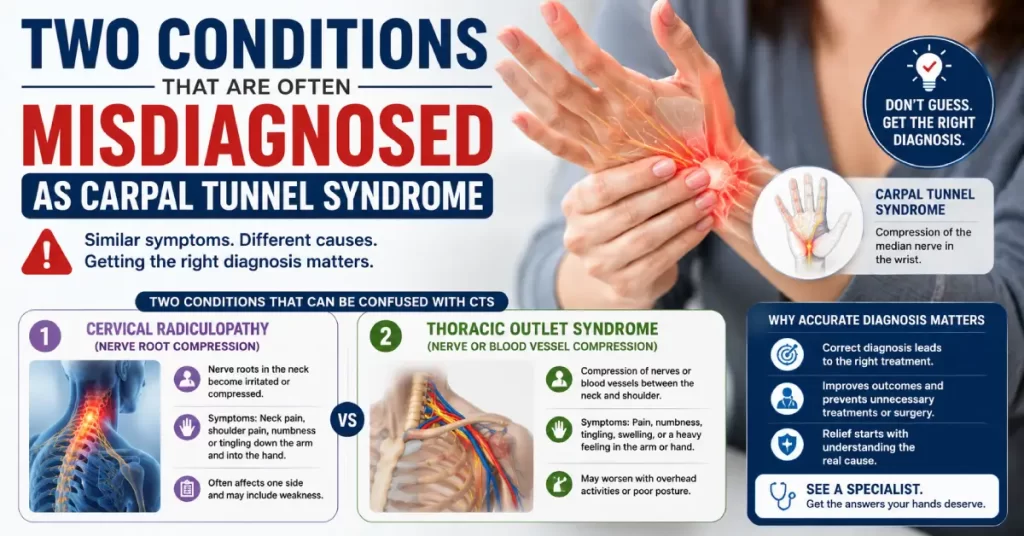
Two Conditions That Are Often Misdiagnosed as Carpal Tunnel Syndrome
Introduction
Tingling in your hand. Numbness creeping down your fingers at night. And everyone says the same thing — “carpal tunnel” — because honestly, that’s the name people already know. But nobody mentions this part upfront: two conditions that are often misdiagnosed as carpal tunnel syndrome cause almost the exact same symptoms, and treating the wrong one can leave you stuck for months.
That’s not a small deal either. Wrist surgery won’t do much if your actual problem’s sitting somewhere else — up the arm, or even the neck. So before you agree to a splint, an injection, or surgery, it’s worth figuring out what else might actually be going on here.
Carpal Tunnel Syndrome, the Short Version
It happens when the median nerve — running through a narrow passage in your wrist — gets squeezed. That squeeze causes tingling, numbness, weakness, usually in the thumb, index, middle finger, half the ring finger too. Typing a lot, repetitive hand motion, health stuff like diabetes — all of it can raise your odds.
It’s common. Really common, and that’s kind of the problem. Because it’s the name everyone knows, doctors and patients both sometimes jump straight there without checking the lookalikes first. I’ve seen that shortcut cause real trouble for people more than once.
Why Misdiagnosis Happens So Much
Nerve compression symptoms overlap a ton, condition to condition. Tingling, numbness, a weak grip — shows up whether the problem’s in your wrist, your elbow, or up in your neck somewhere. People assume any hand tingling equals carpal tunnel automatically, when the real source might be several inches away entirely.
Doctors without nerve testing handy sometimes go mostly off what the patient describes, rather than a full exam or a conduction study. Not negligence, not really. Carpal tunnel’s just the statistically likely answer, so it gets assumed first — even when it’s the wrong call.
Condition One: Cervical Radiculopathy
Happens when a nerve gets pinched as it exits the spine in your neck, usually from a herniated disc or bone spur. That nerve runs down through the shoulder and arm, so the symptoms can copy carpal tunnel almost exactly — especially when it hits the nerve roots feeding the hand.
How to Tell Cervical Radiculopathy Apart From Carpal Tunnel?
- Notice where it actually starts. Neck or shoulder first, usually, before it travels down.
- Pay attention to neck movement. Turning or tilting the head tends to worsen this — carpal tunnel doesn’t do that.
- Check which fingers are involved. Carpal tunnel usually leaves the pinky alone; radiculopathy can hit it depending which nerve root’s pinched.
- Watch the nighttime pattern. Carpal tunnel classically wakes people up. Radiculopathy’s less tied to that.
- Get an MRI of the neck if the exam points this way — really the only solid way to confirm a disc or spur.
Doctors often test this with Spurling’s test — tilting and pressing the neck to see if it reproduces arm symptoms. Reproduces them? Strong sign it’s not your wrist at all.
Condition Two: Cubital Tunnel Syndrome
This one’s the ulnar nerve, not median, compressed at the elbow instead of the wrist. Cubital tunnel gets confused with carpal tunnel constantly, since both cause hand numbness and tingling — just different fingers involved.
Complete Steps to Differentiate Cubital Tunnel From Carpal Tunnel
- Which fingers go numb first? Ring and pinky for cubital tunnel; thumb, index, middle for carpal tunnel.
- Test elbow sensitivity. Tapping it, bending it, resting it on a table — often sets off cubital tunnel specifically.
- Look at the weakness pattern. Cubital tunnel can weaken the grip between thumb and pinky, sometimes showing up as “clawing” in bad cases.
- Ask if leaning on your elbow makes it worse. That’s the classic tell for cubital tunnel — carpal tunnel just doesn’t do this.
- Ask for a nerve conduction study covering both the median and ulnar nerves. Separates the two pretty clearly.
Plenty of people get treated for carpal tunnel for months — wrist splint, no relief — before someone finally checks the elbow and finds where the problem’s actually been hiding the whole time.
Symptom Comparison Table
| Feature | Carpal Tunnel Syndrome | Cervical Radiculopathy | Cubital Tunnel Syndrome |
|---|---|---|---|
| Nerve involved | Median nerve | Spinal nerve root | Ulnar nerve |
| Compression site | Wrist | Neck | Elbow |
| Fingers affected | Thumb, index, middle | Varies by nerve root | Ring and pinky |
| Neck movement effect | None | Often worsens symptoms | None |
| Elbow sensitivity | None | None | Often triggers symptoms |
| Common trigger | Repetitive hand use | Herniated disc, bone spur | Leaning on elbow, prolonged bending |
Why the Right Diagnosis Actually Matters
Wrong treatment burns time. Sometimes money too, on things that were never going to help. Wrist surgery doesn’t fix a pinched nerve up in the neck. A neck brace does nothing for a squeezed ulnar nerve at the elbow. This is where the frustration piles up — people doing everything “right” and still feeling no better months down the line.
There’s more riding on it than wasted effort, too. Nerves left compressed too long can suffer real, permanent damage. So catching the right diagnosis early actually protects your hand and arm function long term, not just your patience.
How Doctors Land on the Right Diagnosis
Step-by-Step Guide to Proper Diagnosis
- Physical exam first — reflexes, strength, sensation checked across neck, shoulder, arm, hand.
- Specific tests get run next. Tinel’s sign at the wrist, Spurling’s test for the neck, elbow flexion tests for cubital tunnel.
- Nerve conduction study and EMG usually follow — measuring how well signals travel through each nerve specifically.
- Imaging like MRI or X-ray if a structural issue in the neck or elbow seems likely.
- Put it all together, and the doctor narrows down which nerve — and where — is actually causing this.
Takes longer than handing over a wrist splint, sure. But it’s really the only reliable way to land on the right answer instead of guessing.
Mistakes Patients (and Sometimes Doctors) Make
A handful of mistakes keep showing up in these misdiagnosis stories, over and over.
- Assuming all hand tingling means carpal tunnel, no further checking
- Skipping the neck and elbow exam since the hand’s where it hurts most
- Starting treatment off symptoms alone, no conduction study to back it up
- Ignoring posture, sleep position, or elbow bending as possible contributors
- Sticking with carpal tunnel treatment for months despite zero change, instead of asking for a second opinion
Can You Have More Than One at Once?
Yes, and more often than people expect. It’s entirely possible to have cervical radiculopathy and carpal tunnel at the same time — sometimes called “double crush syndrome,” where a nerve’s compressed at two separate points along its path. Makes diagnosis genuinely trickier, which is exactly why a full exam matters before jumping into treatment.
What Actually Treats Each One?
Treatment shifts quite a bit depending on which nerve, and where.
- Carpal tunnel syndrome: wrist splinting, changing activity, corticosteroid injections, surgery for severe or persistent cases
- Cervical radiculopathy: physical therapy, anti-inflammatory meds, cervical traction, surgery sometimes if the herniation’s bad
- Cubital tunnel syndrome: elbow padding, avoiding prolonged bending, night splints keeping the elbow straight, surgery for advanced compression
Trying the wrong one first isn’t just useless. It delays real care long enough that recovery gets harder later.
When Should You See a Specialist?
Symptoms not improving after a few weeks of standard carpal tunnel treatment? That’s usually a sign something else is going on. A neurologist or orthopedic specialist can run the deeper nerve testing a general doctor sometimes skips on a first visit.
- Symptoms not improving despite splinting and rest
- Pain traveling up into the shoulder or neck, not staying in the hand
- Numbness concentrated specifically in ring and pinky
- Weakness that’s getting worse, not better
- Any pattern that just doesn’t quite fit textbook carpal tunnel
Does Physical Therapy Help With These?
Yes, genuinely, across all three, though the exercises differ. For cervical radiculopathy, therapy usually targets neck mobility and posture. For cubital tunnel, it’s more about reducing elbow pressure and improving nerve gliding. A therapist who knows nerve compression well can often tell which condition’s at play just from how your body responds to certain movements.
Why Do These Two Keep Getting Confused With Carpal Tunnel?
Cervical radiculopathy and cubital tunnel share the same basic setup as carpal tunnel — a nerve squeezed somewhere along its path, tingling and numbness showing up downstream. None of these come with an obvious visible injury, and symptoms overlap so much right there in the hand, it’s easy to see why the wrong diagnosis can stick around for months unquestioned.
Conclusion
Hand tingling and numbness feel like carpal tunnel because that’s the name everybody already knows. But cervical radiculopathy and cubital tunnel syndrome are two conditions that are often misdiagnosed as carpal tunnel syndrome precisely because the symptoms overlap so closely in the hand and fingers.
Getting this right matters more than people realize going in. Wrong treatment wastes time, delays real recovery, and sometimes lets nerve damage progress further than it should have. A proper exam, plus nerve conduction testing when needed, is still the clearest way to actually know what’s going on.
If carpal tunnel treatment isn’t working after a few weeks, don’t just keep waiting it out. Ask your doctor to check your neck and elbow too — could save you months of chasing the wrong problem.
Frequently Asked Questions
Can carpal tunnel syndrome be misdiagnosed?
Yes, fairly often actually. Tingling and numbness in the hand can come from several different nerve compression sites, so carpal tunnel sometimes gets diagnosed without ruling out the neck or elbow first.
What condition mimics carpal tunnel syndrome the most?
Cubital tunnel syndrome comes closest, since it also causes hand numbness and tingling. Main difference is which fingers — ring and pinky for cubital tunnel, thumb and middle for carpal tunnel.
How do I know if it’s my neck and not my wrist causing the tingling?
If turning or tilting your neck changes your arm or hand symptoms, that points toward your neck, not your wrist. Carpal tunnel symptoms generally don’t shift with neck position at all.
Is a nerve conduction study necessary before treatment?
Not always required, but it’s genuinely the most reliable way to confirm which nerve’s actually compressed. Skip it, and treatment decisions rest mostly on guesswork.
Can cervical radiculopathy go away without surgery?
Yes, plenty of cases improve with physical therapy, anti-inflammatory medication, and time — especially if it’s a mild disc bulge rather than a severe herniation. Surgery’s usually the last resort.
Does a wrist splint help if I actually have cubital tunnel syndrome?
Not really. A wrist splint targets the median nerve at the wrist; cubital tunnel is the ulnar nerve at the elbow. Wearing one probably won’t help if the elbow’s the real problem.
Can I have carpal tunnel and cervical radiculopathy at the same time?
Yes, happens more than people think — sometimes called double crush syndrome. Makes diagnosis more complex, which is exactly why checking the neck, elbow, and wrist together matters so much.
Should I get a second opinion if carpal tunnel treatment isn’t working?
Worth considering, definitely. If splinting, rest, or injections haven’t helped after several weeks, a specialist can check for cervical radiculopathy or cubital tunnel instead of repeating treatment that clearly isn’t working.


