

Let me be real with you for a second. Most people think CPR is just… CPR. Same steps, same rhythm, same idea every time. Press, breathe, repeat. That’s what we’ve all seen somewhere, right? But the moment choking is involved, that “standard” approach doesn’t fully work anymore. And that’s exactly why the question how does Cpr differ in an unresponsive adult choking victim matters more than people expect.
Imagine this. Someone is eating, maybe laughing, maybe distracted. Suddenly they stop. No sound. No coughing. Just panic in their eyes. Then—collapse. Now your brain goes blank for a second. Do you do CPR? Do you check the mouth? Do you wait?
That confusion is common. And honestly, it’s dangerous.
Understanding how does Cpr differ in an unresponsive adult choking victim isn’t about memorizing steps. It’s about knowing what problem you’re actually trying to fix. Because here’s the catch—this isn’t just about the heart. It starts with air.
What Happens During Adult Choking Emergencies?
Choking doesn’t always look dramatic like in movies. Sometimes it’s quiet. Too quiet.
A person might try to cough, but nothing comes out. They may grab their throat, or just freeze. One thing you’ll notice—no proper sound. That’s usually the giveaway.
What’s happening inside is simple, but serious. Something is stuck in the airway. Food, maybe. A small object. Doesn’t matter. It blocks the path air needs to travel.
And once that path is blocked… oxygen stops moving.
I’ve seen people hesitate here, thinking, “Maybe it’ll pass.” Sometimes it does. But when it doesn’t, things move fast. Faster than most people expect.
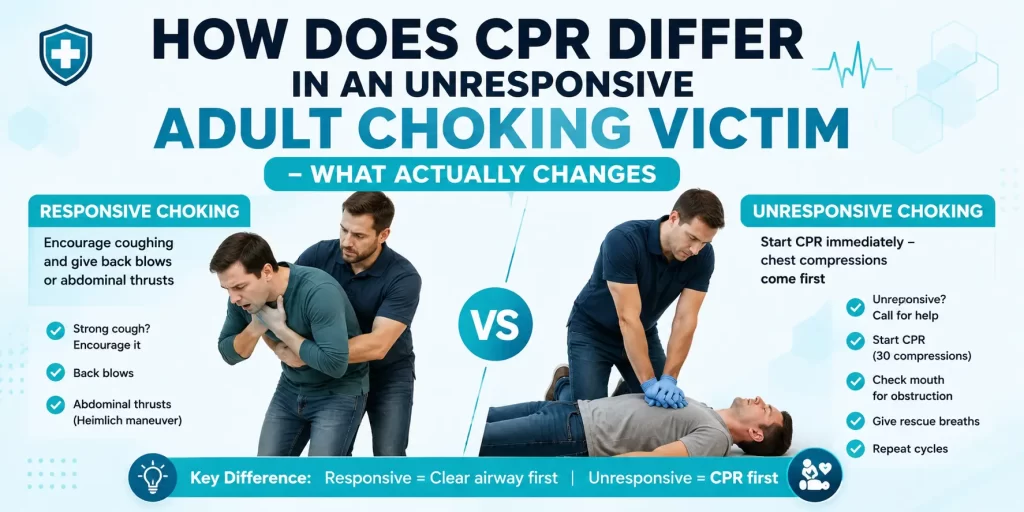
Why Oxygen Deprivation Becomes Life-Threatening Quickly
Here’s something that surprises people. The body doesn’t have a backup plan for oxygen. There’s no reserve tank you can rely on for long.
Within a few minutes—literally a few—the brain starts to struggle. Not in a dramatic way at first. But damage begins quietly.
And here’s the tricky part. In choking, the heart might still be beating when the person becomes unresponsive. That confuses people. They think, “If the heart is still working, why CPR?”
Because the real issue is airflow, not circulation—at least in the beginning.
That’s the key difference most people miss.
How Does Cpr Differ In An Unresponsive Adult Choking Victim?
So let’s answer it properly. Not textbook style. Real-world style.
When people ask how does Cpr differ in an unresponsive adult choking victim, what they’re really asking is: “What should I do differently right now?”
Here’s the honest answer—you’re doing CPR, yes. But you’re also trying to fix a blockage at the same time.
That changes your focus.
In normal CPR, you’re trying to keep blood moving because the heart isn’t doing its job. But in choking, even if blood moves, it won’t carry oxygen unless air gets in first.
So now chest compressions do something extra. They create pressure inside the chest. And sometimes—this is important—that pressure can help push the stuck object out.
Not guaranteed. But possible.
Key Differences Between Standard CPR and Choking CPR
This is where things start to separate clearly.
Airway Obstruction vs Cardiac Arrest
In standard situations, the airway is usually open. You give breaths, and air goes in. Simple.
But in choking, that pathway is blocked. Completely or partially.
So even if you give perfect breaths, nothing happens. No chest rise. No air movement. That’s your clue.
Importance of Clearing the Airway First
Now here’s where people mess up. They rush.
They start breathing immediately without checking the mouth. But if something is sitting there, those breaths won’t help. They might even push it deeper.
So instead, you pause—just for a second—and look.
If you see something clearly, remove it. Carefully. No digging around blindly. That usually makes things worse, not better.
Signs an Adult Choking Victim Has Become Unresponsive
This moment… it can feel sudden.
One second they’re struggling. Next, they’re still. No reaction when you call them. No movement.
That’s your signal.
You don’t wait. You don’t second guess. You act.
Sometimes their body just goes limp. Sometimes their skin tone changes slightly. Lips may turn a bit bluish. It’s subtle, but once you see it, you know something is very wrong.
Warning Signals You Should Never Ignore
If you’re unsure, look for these:
- No response when you speak or touch
- Breathing stops or becomes irregular
- Body collapses or loses strength
- Skin looks pale or slightly blue
Even one or two of these signs together should push you to act immediately.
Why Standard CPR Alone Is Not Enough in Choking Cases
This part is uncomfortable, but important.
Doing standard CPR without thinking about the blockage can waste time. And time is the one thing you don’t have much of here.
If air can’t enter, oxygen can’t reach the lungs. And if that doesn’t happen, everything else becomes less effective.
I’ve seen people focus only on compressions, forgetting to check the airway at all. It’s not that they’re wrong—it’s just incomplete.
The Hidden Danger of Blocked Airways
Think of it like trying to inflate a balloon that has something stuck inside its neck. You can blow as hard as you want—it won’t expand.
That’s what rescue breaths are like when the airway is blocked.
So the approach shifts slightly. You still do compressions, yes. But you stay aware of the airway. You keep checking. You look for any chance to clear it.
How to Perform CPR on an Unresponsive Choking Adult
Alright. No overthinking now. Just clear actions.
Step-by-step guide
- Check if they respond
Tap them. Call out. If nothing happens, move quickly. - Call emergency help
If someone’s nearby, tell them directly. Don’t assume they’ll act on their own. - Start chest compressions
Hands in the center. Push hard. Keep a steady rhythm. Don’t worry about being perfect—just don’t stop. - Open the airway
Tilt the head slightly back and lift the chin. - Look inside the mouth
If you see something obvious, remove it gently. - Try giving breaths
Watch the chest. If it doesn’t rise, the blockage is still there. - Repeat the cycle
Compressions. Check. Breaths. Repeat.
When Should You Call Emergency Services?
Immediately.
Not after trying for a while. Not after checking everything. Just… immediately.
If someone else is there, point to them and say it clearly. “Call now.” That works better than shouting generally.
Timing Can Save a Life
Every minute matters here. That’s not an exaggeration.
Even if you’re doing everything right, professional help adds another layer of support that can make a huge difference.
Common Mistakes People Make During Choking CPR
People don’t fail because they don’t care. They fail because the situation is intense and confusing.
And honestly, that’s understandable.
Errors That Can Reduce Survival Chances
- Forgetting to check the airway
- Trying to remove something blindly
- Giving breaths without clearing blockage
- Waiting too long before starting
- Stopping too early
Even fixing one of these mistakes can improve the outcome.
How to Check the Airway Safely
This part… people either rush it or overdo it. There’s rarely an in-between.
When you’re in that moment, your brain is already moving fast. You want to do something, anything. But checking the airway isn’t just a quick glance—it’s more like a quick but focused look. Not long, not careless either.
Sometimes the object is obvious. Like, right there. Other times… it’s not so clear. That’s where people get stuck.
And honestly? If you don’t see anything, that doesn’t always mean nothing is there. It just means you don’t go digging blindly.
Step-by-step guide
- Tilt the head back a little
Not too much. Just enough to open things up so you can see better. - Look inside, don’t rush it
Give it a second. Your eyes need a moment to adjust. - If you see something, remove it gently
No force. Just careful movement. - If you don’t see anything, stop there
Don’t try to “guess” where it is. - Check again after compressions
Things can move. What wasn’t visible before might show up later.
Compression Techniques in Choking CPR
Here’s something that surprises people—chest compressions are doing more than one job here.
Most people think, “Okay, compressions = blood flow.” That’s true. But in choking, there’s this second effect happening. Pressure builds up inside the chest.
And that pressure? It can sometimes push the object out.
Not always. I wish it worked every time, but it doesn’t. Still, it’s one of the few things you can do at that moment.
Also, quick note—people tend to go too soft. Probably because they’re scared of hurting the person. That hesitation… It reduces effectiveness.
How Chest Compressions Help Dislodge Objects
Each push creates a kind of internal force. It’s not visible, obviously, but it’s there.
Think of it like this—if something is stuck in a narrow tube, pressure from below might shift it. Same idea here.
So yeah, steady, firm compressions matter. Not perfect. Just consistent.
Rescue Breaths in a Blocked Airway Situation
This is where people start second-guessing themselves.
“Should I even give breaths if something is stuck?”
Fair question. And the answer isn’t a simple yes or no—it depends on what you see.
You try. But you also observe.
Should You Still Give Breaths?
Give breaths, but don’t just keep going blindly.
Watch the chest.
If it rises, good—that means air is getting through. If it doesn’t… then something is still blocking the way.
And when that happens, you go back. Compressions again. Then check again.
It’s a bit of a loop. Not a fixed script.
Comparing CPR Techniques (Table)
Sometimes it helps to just lay things out simply.
Standard CPR vs Choking CPR
| Situation | Standard CPR | Choking CPR |
| Main issue | Heart problem | Air blocked |
| Airway | Open | Not clear |
| Focus | Blood flow | Air + blood |
| Breaths | Regular | Only after checking |
| Compressions | Circulation | Circulation + pressure effect |
Real life won’t look like this table, of course. But it gives you a rough idea to hold onto.
Tips to Improve Survival Chances
This isn’t about doing everything perfectly. That’s not realistic.
It’s more about… not freezing.
I’ve noticed something—people who act quickly, even if slightly messy, often do better than those who hesitate trying to be perfect.
Real-Life Practical Advice
- Start fast
Even if you’re unsure, doing something is better than waiting. - Stay with it
Don’t stop after a short time. It can take longer than you expect. - Keep checking
Airway, breathing, response—things change. - Don’t panic if nothing happens immediately
Sometimes there’s no instant result. That doesn’t mean it’s not working.
Conclusion
So if you strip everything down, how does Cpr differ in an unresponsive adult choking victim really comes down to awareness.
You’re not just doing CPR—you’re dealing with a blockage at the same time.
That’s it.
Once you understand that, your actions start to make more sense. You check the airway more often. You pay attention to chest movement. You don’t just follow steps blindly.
And yeah… in real situations, it won’t feel clean or organized like this. It’ll feel messy and fast.
But even then, knowing this difference can guide you.
And that’s what matters.
FAQs
What makes choking CPR different?
It’s mainly about the airway. In choking, air can’t pass through, so you need to keep checking and adjusting. It’s not just compressions and breaths—it’s also about removing the blockage.
Can chest compressions remove an obstruction?
Sometimes, yes. The pressure from compressions can shift or dislodge the object. It doesn’t always happen, but it’s one of the reasons compressions are still important.
Should I perform abdominal thrusts if unconscious?
No, once the person is unresponsive, you switch to CPR. Abdominal thrusts are for conscious choking cases.
How long should CPR continue?
Until help arrives or the person starts breathing again. It might feel long, but stopping too early can reduce the chances of recovery.
Is training required for choking CPR?
Training helps, definitely. But even basic understanding—like what you’ve read here—can make a real difference in an emergency.


