

How Long Does It Take For A Body To Disintegrate
So yeah, this question—how long does it take for a body to disintegrate—comes up more often than people admit. And most expect a clean answer like “a week” or “a year.” But it doesn’t really work like that. The timeline can swing a lot. I mean, we’re talking weeks in some cases… and years in others.
What makes it tricky is that decomposition isn’t controlled. It’s not like setting a timer. It depends on where the body is, what the weather is doing, and even things like insects or soil type. A body left outside in heat? That breaks down pretty fast. Same body buried deep underground? Completely different story. From what I’ve seen over time, even small changes—like shade versus direct sun—can shift the speed more than you’d expect.
Understanding Human Decomposition
Decomposition sounds like a heavy word, but really, it’s just nature doing cleanup. The body breaks down and returns to the environment. Nothing dramatic about the concept itself… but the process? That’s where it gets detailed.
And here’s something people don’t always realize—this whole thing starts almost immediately. Not later. Not after a day. Pretty much right away. Once the heart stops, oxygen stops moving, and cells begin to fail. It’s quiet, but it’s happening.
What Happens After Death?
Right after death, the body enters a kind of transition phase. It doesn’t just “shut off” instantly. Instead, things begin to change internally first. Cells lose oxygen and start breaking apart. This is where autolysis begins—basically, the body starts digesting itself from the inside.
At the same time, bacteria—especially in the gut—begin spreading. These bacteria were harmless before, but now they play a big role in decomposition. It’s strange, but also kind of fascinating. The body already has everything it needs to break itself down. Nothing external is required to start the process.
Why Decomposition Time Varies
This is where things stop being predictable. There isn’t one timeline because too many things affect it. Temperature is a big one. Warm weather speeds everything up. Cold slows it down—sometimes a lot more than people expect.
Moisture also plays a role. A damp environment helps bacteria grow faster. Dry air? That can actually slow body decomposition or even partially preserve tissues. Then there are insects. If a body is exposed, insects can accelerate the process quickly. If it’s sealed away, that whole part is missing.
So really, it’s not one process—it’s a mix of many small things happening together.
Stages of Human Body Decomposition
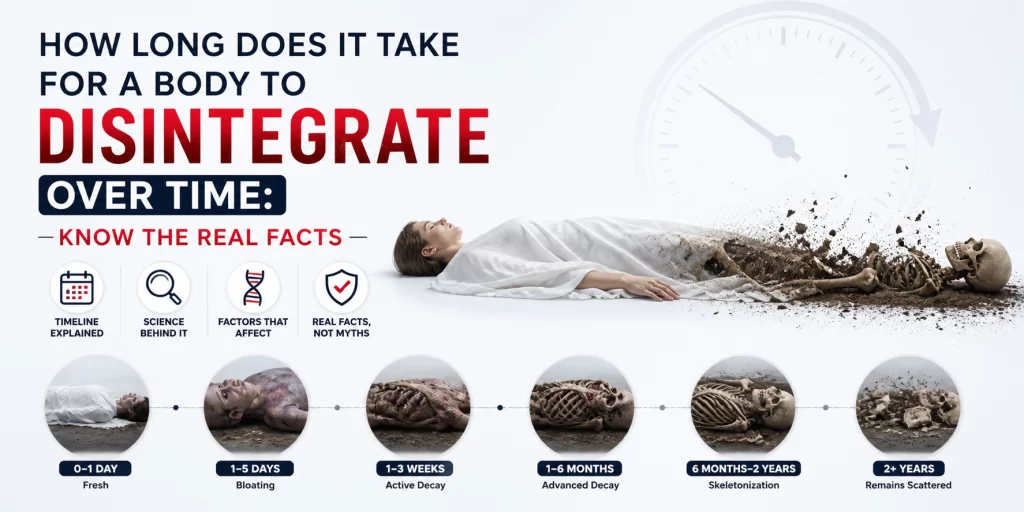
Even though timing changes, the stages themselves are fairly consistent. The body goes through them in order. Think of it like phases—you can’t skip one, but you can stretch or compress how long each lasts.
In real situations, though, these stages don’t always look exactly the same. Weather changes things. So does location. Still, the general pattern holds up.
Fresh Stage Explained
This stage begins immediately after death. Usually lasts a couple of days, give or take. From the outside, the body might still look normal. Nothing too obvious yet.
But internally, a lot is happening. The body cools down. Muscles start to stiffen—this is rigor mortis. Blood settles in certain areas due to gravity. It’s subtle stuff. If you didn’t know what to look for, you might miss it completely.
This stage is quiet, but important. It sets everything else in motion.
Bloat Stage and Changes
After a few days, things start to shift more visibly. The bloat stage begins. Gas builds up inside the body due to bacterial activity, and that causes swelling.
You might notice changes in color—greenish tones, sometimes darker patches. The smell becomes stronger too. Not easy to ignore at this point. Pressure builds up internally, and in some cases, it can cause the skin to stretch or even break.
It’s not pleasant, but it’s part of the natural breakdown process.
Active Decay Stage
This is where things move fast. Really fast. The body starts losing mass quickly as tissues break down. Fluids are released, and the structure of the body begins to collapse.
If the body is exposed, insects play a huge role here. They speed things up more than most people realize. From what I’ve seen in documented cases, a large portion of decomposition happens during this stage.
It’s messy, intense, and very dependent on the environment.
Advanced Decay Stage
By now, most of the soft tissue is gone. What remains are smaller fragments—some tissue, cartilage, and bones. The pace slows down compared to earlier stages.
There’s less smell, fewer insects, and overall less activity. It’s quieter again, in a way. This stage can last a while depending on conditions. Weeks, sometimes longer.
Dry Remains Stage
This is the final stage. Mostly bones are left, maybe some dry skin or hair. There’s very little moisture, so decomposition slows almost to a stop.
At this point, environmental factors take over more than biology. Things like soil acidity, weather, and exposure determine how long the remains last. In some cases, bones can remain for years.
How Long Does It Take For A Body To Disintegrate in Different Conditions
This is really the core of the question. Because when people ask how long does it take for a body to disintegrate, what they usually mean is—under what conditions?
And honestly, that’s the only way to answer it properly. The same body can break down quickly in one place and slowly in another. Environment changes everything.
In Open Air
In open air, decomposition tends to happen faster. There’s oxygen, temperature changes, and insects—all working together.
In warm conditions, the process speeds up a lot. You can see major changes in just a few days. In some cases, skeletonization can begin within weeks. But if it’s cold or dry, things slow down.
Still, compared to other environments, open air is one of the fastest.
Underground Burial
Burial slows things down. Not always dramatically, but noticeably. The lack of oxygen and limited insect access changes how decomposition works.
Soil type matters too, more than people think. Clay soil tends to hold moisture and slow things. Sandy soil allows more airflow, which can slightly increase decomposition speed.
Depth also plays a role. Deeper burial usually means slower breakdown. In many cases, full decomposition underground can take years.
How Long Does It Take For A Body To Disintegrate
So… if we’re being real about it, there isn’t a clean answer here. When someone asks how long does it take for a body to disintegrate, what they usually want is a number. Like “10 days” or “6 months.” But that’s not really how this works.
It can be fast. It can be very slow. Sometimes surprisingly slow.
A body left out in heat, for example, can start breaking down in a matter of days. Not fully, of course—but noticeable changes happen quickly. But take that same situation and change just one thing—temperature, for instance—and suddenly everything shifts. Cold slows things down a lot. Like… more than most people expect.
And then there’s the environment. Soil, water, air—it all changes the pace. Even something small, like whether the body is in shade or direct sunlight, can push things in a different direction. So yeah, there’s no fixed timeline. It’s more like a range that keeps stretching depending on conditions.
Understanding Human Decomposition
Decomposition sounds like a complicated word, but the idea behind it is simple. The body breaks down. That’s it. Nature reuses what’s there.
But the way it happens… that part is a bit more layered.
It actually begins almost right away. Not in a dramatic way—nothing visible at first—but internally, things start shifting. Cells stop getting oxygen, and once that happens, they begin to break apart. Quiet process, but constant.
And here’s something people don’t usually think about—the body kind of triggers its own breakdown. Enzymes that once helped with digestion start working in a different way. They begin breaking down tissues instead. So in a sense, the process starts from within before anything external really kicks in.
Why Decomposition Time Varies
This is where things stop being predictable.
Temperature matters a lot. Probably the most. Warm conditions speed things up, cold slows them down. Simple idea—but the effect is huge. Like, not small differences… big ones.
Moisture also plays a role, though people don’t always think about it. Wet environments tend to support faster breakdown. Dry ones? They can actually slow things down, sometimes even preserve parts longer than expected.
And then insects. If a body is exposed, insects can accelerate decomposition quickly. But if access is limited—like underground or sealed—that whole factor disappears.
So instead of one timeline, you end up with… layers of influence. Everything stacking together.
In Open Air
Open air is usually faster. Not always—but most of the time.
There’s oxygen, there’s heat, and there are insects. All of those push decomposition forward. In warmer climates especially, changes can happen pretty quickly. Sometimes within just a few days, you’ll start seeing clear signs.
But again, it depends. If the weather is cold or dry, things slow down. Not completely, but noticeably. So even here, it’s not one fixed speed—it shifts.
Still, compared to other conditions, open air tends to be on the faster side.
In a Coffin
A lot of people assume coffins stop decomposition. They don’t.
They slow it down, sure—but they don’t stop it.
What really changes is the environment around the body. Less air, fewer insects, more controlled space. That alone makes a difference. But then you also have moisture, and that can go either way. If it builds up, it can actually support certain types of breakdown instead of preventing it. So always the answer is different for “How Long Does It Take For A Body To Disintegrate?”
So it’s not as simple as “sealed equals preserved.” It’s more like… altered conditions, depending on those conditions, decomposition can take a long time. Years, sometimes longer.
Conclusion
So yeah—there isn’t one clean answer to how long this takes.
It depends. On a lot of things.
Environment, temperature, exposure—all of it matters. In some cases, the process moves quickly. In others, it stretches out over years. Same body, different conditions, completely different timeline.
If you’re trying to understand it, it helps to stop thinking in exact numbers. Think in ranges instead. Think in conditions.
That’s where the real answer is.
FAQs
How long does it take for a buried body to fully decompose?
It usually takes several years for a buried body to fully decompose. The exact time depends on soil type, depth, and environmental conditions. In some cases, it can take over a decade for complete breakdown.
Does a body decompose faster in water or air?
In most cases, decomposition is faster in open air due to oxygen and insect activity. Water can either speed up or slow down the process depending on temperature and movement.
Can a body stop decomposing completely?
Not exactly. Decomposition can slow down significantly, especially in cold or dry environments, but it rarely stops entirely. Some conditions can preserve remains for long periods, though.
How long does it take for a body to become a skeleton?
In warm, open environments, skeletonization can begin within weeks. In other conditions, it may take months or even years depending on external factors.
Do coffins prevent decomposition?
No, coffins do not prevent decomposition. They only slow it down by limiting exposure to air, moisture, and insects.


