

Introduction
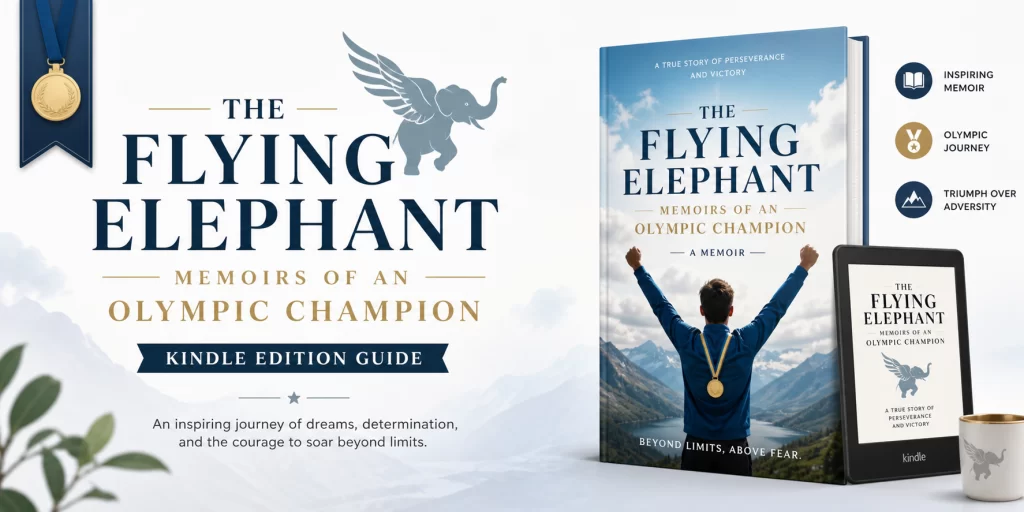
You know how some books feel like they’re trying too hard to inspire you? This one doesn’t. The Flying Elephant Memoirs Of An Olympic Champion Kindle Edition feels quieter than that—almost like someone speaking honestly without worrying how it sounds. And that’s probably why it works. It doesn’t rush to impress. It just… unfolds, slowly, sometimes unevenly, but in a way that feels real.
When I started reading The Flying Elephant Memoirs Of An Olympic Champion Kindle Edition, I didn’t expect to pause this often. Not because it’s confusing—but because certain lines make you stop and think. Not in a dramatic way. More like, “hmm… yeah, that actually makes sense.” It’s less about big moments and more about those small internal shifts we don’t usually talk about.

Free Download CapCut Pro – with all premium features unlocked, No Watermark, No Ads, 4K export.
Introduction to the Book
At first glance, you might assume it’s another sports memoir. Training, discipline, victory—all that. And yes, those elements are there. But they don’t dominate the story. Instead, the book leans into the in-between moments. The doubts. The hesitation before decisions. The times where nothing seems to move forward.
Honestly, that’s what makes it different. It doesn’t try to clean up the messy parts. In fact, it leaves them exactly as they are. Sometimes a thought feels unfinished. Sometimes a transition feels abrupt. But weirdly, that adds to the authenticity. Life isn’t structured neatly, so why should a life story be?
Why this memoir is gaining attention?
People are picking up on that rawness. It doesn’t sound like it was filtered ten times before publishing. It feels closer to how someone would actually remember their life—bits and pieces, not always in perfect order. And readers seem to trust that more.
About the Author and Olympic Journey
The Olympic part is important, obviously. But it’s not the whole story. If anything, it feels like just one layer. Underneath that, there’s a constant thread of uncertainty—questioning choices, dealing with pressure, trying to understand what success even means.
From what I’ve seen, most people imagine athletes as extremely focused all the time. This book kind of challenges that idea. There are moments where focus slips. Where motivation isn’t strong. And instead of hiding that, the author leans into it.
Early life and struggles
The early years aren’t dramatized. No over-the-top storytelling. Just a straightforward look at what things were like. Limited options, unclear direction, and a lot of trial and error.
And maybe that’s the point—it doesn’t try to make struggle look heroic. It just shows it as something normal. Something that happens before anything meaningful begins.
Olympic achievements and milestones
Reaching the Olympic stage doesn’t suddenly simplify things. If anything, it complicates them. Expectations grow, pressure builds, and every decision starts to feel heavier.
Winning is mentioned, yes. But it’s not described like a grand finale. It’s more reflective, almost quiet. Like the author is still processing what it all meant, even after the fact.
What is The Flying Elephant Memoirs Of An Olympic Champion Kindle Edition About?
It’s tempting to say this book is about success. But that wouldn’t be accurate. It’s more about persistence—continuing even when clarity isn’t there.
The title itself is a bit strange, right? A flying elephant doesn’t make logical sense. And maybe that’s intentional. The story keeps hinting at the idea that not everything needs to make sense in the beginning.
Core theme and storytelling style
The writing doesn’t try to be impressive. No complex words, no heavy descriptions. Just simple language that carries weight because of the meaning behind it.
There’s also something slightly unpredictable about the structure. It doesn’t always follow a straight line. Memories appear, disappear, then connect later. It might throw you off at first—but then it starts to feel natural.
Key life lessons shared in the book
The interesting thing is, the book never says, “here’s the lesson.” You kind of arrive at it yourself. Through situations, through reflections.
Some ideas show up more than once—patience, discipline, dealing with failure—but never in exactly the same way. It’s not repetitive, just… consistent in a human way.
Why Readers Are Loving This Kindle Edition
Reading this on Kindle changes the experience slightly. In a good way. It feels more personal, maybe because you’re holding a device that’s already part of your daily life.
Also, it’s easier to go back and reread certain parts. And this is definitely the kind of book where you’ll want to do that.
Emotional connection with readers
The connection builds slowly. It’s not instant. But once it clicks, it stays.
Because the author doesn’t present a perfect version of events. There are gaps, uncertainties, even contradictions at times. And that makes it feel… honest.
Digital reading experience benefits
There’s something convenient about being able to read a few pages, pause, then come back later without losing the flow.
No effort, no setup. Just open and continue. For a reflective book, that actually matters more than you’d think.
Key Highlights From the Memoir
The most memorable parts aren’t always the ones you expect. Not the victories. Not the big announcements.
It’s usually the quieter moments. A decision. A realization. A shift in thinking that doesn’t look dramatic from the outside—but changes everything internally.
Inspiring moments that stand out
There are points where progress just… stops. No clear reason. Things don’t improve. And it’s frustrating to read—but also very real.
Instead of a sudden breakthrough, the recovery is slow. Almost unnoticeable at first. And that’s what makes it believable.
Challenges and turning points
The challenges go beyond physical limits. A lot of it is mental—self-doubt, pressure, expectations.
One turning point stands out—not because it’s dramatic, but because it’s subtle. The moment the author stops trying to prove something outwardly, and starts focusing inward.
Benefits of Reading This Memoir
It’s a bit strange to explain, but this book doesn’t hit you all at once. It kind of… builds quietly. Like you read a few pages, nothing dramatic happens, and then later—maybe while doing something else—you remember a line. That’s the effect it has.
A lot of books try to push motivation directly at you. This one doesn’t. It almost avoids that. Instead of saying “be strong” or “never give up,” it shows situations where things didn’t work out, where progress stalled, where the author wasn’t even sure what to do next. And somehow, that feels more useful.
I found myself thinking less about “success” while reading, and more about process. Not the perfect version of it—the messy version. The kind where you repeat mistakes, doubt yourself, and still continue anyway, even if you’re not fully confident. That shift in thinking… it stays with you.
Personal growth insights
What’s interesting is that the book doesn’t clearly point at lessons. You sort of notice them on your own.
Like, there’s this underlying idea that improvement isn’t always visible. You can be doing the right things and still feel like nothing is changing. That can be frustrating—but the book treats it as normal, not as a problem to fix immediately.
And honestly, that perspective alone can ease a lot of pressure.
Motivation for athletes and beginners
If you’re expecting high-energy motivation, this might feel different. It’s quieter than that.
But for beginners, especially, this approach works better. Because it doesn’t create unrealistic expectations. It doesn’t say “you’ll succeed quickly if you try hard.” It shows that things take time—and sometimes, even time doesn’t feel enough.
Still, progress happens. Just not always in obvious ways.
Who Should Read This Book?
This isn’t one of those books where you need to fit a specific category. You don’t have to be an athlete. You don’t even have to be particularly interested in sports.
If anything, it’s more for people who are in the middle of something. Not at the start, not at the finish—somewhere in between. That phase where things feel uncertain.
I think that’s where the book connects the most.
Ideal audience explained
Maybe you’re a student trying to figure things out, or someone working but feeling a bit stuck. Or even just someone who started something with excitement and now isn’t sure anymore.
That kind of space—the “in-between”—is where this book makes the most sense.
How to Read and Understand This Memoir Better
You can read it straight through. But I wouldn’t recommend that. It’s not that kind of book.
Step-by-step guide
- Don’t rush the beginning
The first few pages might feel slow. That’s fine—just go with it. - Read when you can focus
This isn’t ideal for distracted reading. It works better when you’re actually present. - Stop when something feels meaningful
Not everything will stand out—but when something does, pause. - Go back sometimes
A second read of certain parts feels different. You notice more. - Let it sit
You don’t need to “finish fast.” Let the book stay with you a bit.
Kindle Edition vs Physical Book Comparison
This part is more practical, but still worth thinking about.
| Feature | Kindle Edition | Physical Book |
| Ease of use | Very easy, instant access | Requires carrying |
| Reading style | Flexible | Fixed |
| Revisit sections | Quick | Slower |
| Feel | Private, personal | More traditional |
Which one is better for you?
It really depends on your reading habits.
If you read in short bursts—like a few minutes here and there—Kindle works better. It’s just easier to pick up and continue.
But if you like slowing down, sitting with a book, maybe even rereading pages physically, then the printed version might feel more satisfying.
There’s no strong “winner” here. Just preference.
Common Mistakes Readers Make While Reading Memoirs
This part is actually important, because it changes how you experience the book.
One mistake is expecting constant clarity. Like every chapter should make perfect sense immediately. But that’s not how this memoir works. Some parts feel unclear at first—and only make sense later.
Another mistake is reading it too quickly. Skimming, rushing, trying to “get through it.” That approach doesn’t work well here.
How to avoid them
Slow down a bit. Not dramatically—just enough to notice what’s happening.
Also, don’t try to compare your life directly with the author’s. It’s tempting, but it usually leads to frustration instead of understanding.
Just read it as a story first. The meaning comes later.
Conclusion
After finishing the book, it’s not like everything suddenly changes. There’s no big “aha” moment waiting at the end.
It’s more subtle than that.
You start noticing small shifts in how you think about effort, progress, and even failure. Not in a dramatic way—just slightly different than before. And over time, that difference adds up.
The Flying Elephant Memoirs Of An Olympic Champion Kindle Edition doesn’t try to be loud or overly inspiring. It just tells the story as it is. And maybe that’s exactly why it works.
If you decide to read it, don’t expect perfection. Just go through it slowly. Let it feel a bit unfinished, a bit uneven. That’s where most of its value is anyway.
FAQs
What is this book mainly about?
It focuses on an Olympic journey, but more importantly, it explores the mental and emotional side of that journey—things like doubt, persistence, and slow progress.
Is it easy to read?
Yes, the language is simple. But the ideas can take time to fully sink in, so it’s better read slowly.
Does it give direct advice?
Not really. It doesn’t present clear lessons. Instead, you understand things through the author’s experiences.
Is it suitable for casual readers?
Yes. Even if you’re not deeply into reading, the conversational style makes it approachable.
Should I choose Kindle or physical version?
That depends on your habit. Kindle is more convenient, while physical offers a more traditional reading feel.

