

Okay, so this question—from the results in part B which carbohydrates are ketoses—looks simple at first. But when you actually sit with your lab notes, it suddenly feels… not so simple.
You’re staring at colors, maybe “red appeared,” maybe “light pink after heating,” and you’re like—wait, which one was ketose again?
Yeah, that moment is pretty common.
The thing is, this question isn’t really about memorizing sugar names. It’s more about reading what happened during the test. Like, actually paying attention to how fast something changed, not just what changed. Once you see that, things start to click a bit more.
What Are Ketoses in Simple Terms?
Let’s not overcomplicate this.
Ketoses are just sugars. That’s it. But yeah, there’s a small twist—they have a ketone group inside their structure. You don’t really need to visualize the molecule unless your teacher insists.
What matters more is how they behave.
Because honestly, in lab work, nobody is looking at molecules directly. You’re looking at reactions. Color changes. Timing. That’s how you “see” the difference.
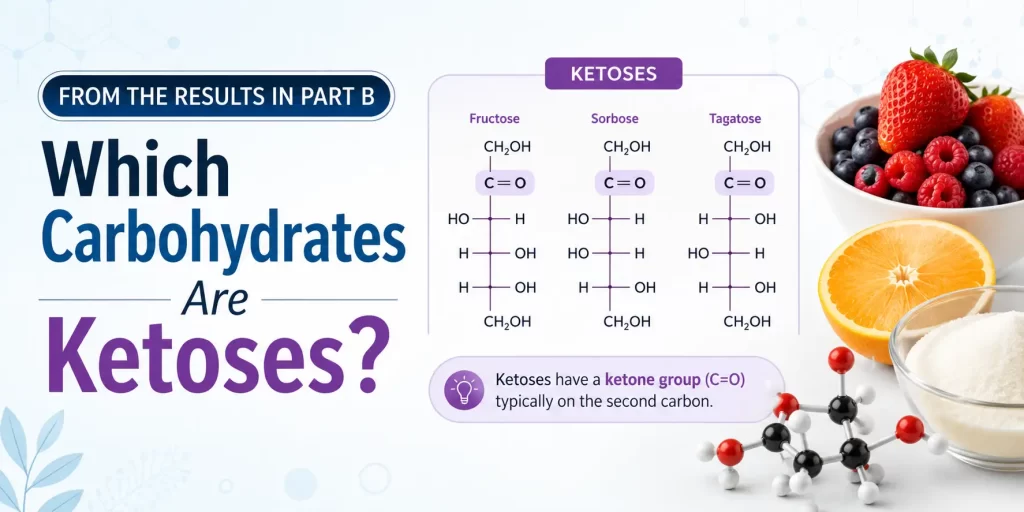
Why Ketoses Matter in Carbohydrate Chemistry
You might feel like this is just exam stuff, but it actually connects to real things.
For example, fructose—like the sugar in fruits—that’s a ketose. So this isn’t some rare chemical you’ll never hear again.
Also, from what I’ve seen, teachers love this topic because it’s one of the first times you actually identify something based on a reaction, not just theory.
From The Results In Part B Which Carbohydrates Are Ketoses?
Alright, back to the main thing—from the results in part B which carbohydrates are ketoses.
Most of the time, Part B involves Seliwanoff’s test. If you remember doing it, there was heating involved, and then… color change.
Now here’s where students usually mess up—they only notice the color, not the speed.
And that’s the whole point.
Ketoses react faster. That’s the shortcut answer, honestly.
Understanding the Lab Results Clearly
Let me put it the way most lab notes actually look.
You’ll probably see something like:
- “Turned red quickly”
- “Slow pink color after heating”
At first glance, both look similar. Both are colors. Easy to mix up.
But the timing—that’s everything here.
Fast reaction? Ketose.
Slow reaction? Probably not.
That’s it. No need to overthink.
Observations from Part B Experiment
In real lab records, nobody writes perfect sentences. It’s usually messy.
Something like:
- “Immediate cherry red”
- “Faint color after 2–3 min”
That difference is actually your answer hiding in plain sight.
Identifying Ketose Indicators
So yeah, if you’re scanning your results, don’t just read—compare.
Which one changed first? Which one reacted stronger?
That one is your ketose.
Simple, but easy to miss if you rush.
Difference Between Aldoses and Ketoses
Now this part… people either memorize it or ignore it.
But honestly, you don’t need deep chemistry here.
Just remember—they’re both sugars, just arranged differently.
Structural Differences Explained Simply
Think of it like this (not perfect, but helps):
- Aldose → functional group at the end
- Ketose → somewhere in the middle
That small shift changes how they react in tests.
You won’t see the structure in lab, but you’ll see the effect of it.
Common Examples of Ketose Sugars
You’ve probably already heard of one without realizing it.
Fructose.
Yeah, the same one in fruits, juices, all that.
In most school labs, if there’s a ketose sample, it’s usually fructose. Not always, but very often.
Everyday Ketoses You Might Know
A few names come up often:
- Fructose
- Ribulose
- Xylulose
But let’s be real—most questions focus on fructose.
How to Identify Ketoses in Laboratory Tests
This is where things get practical again. Not theory—actual steps.
Step-by-step guide
- Take your sample properly
Make sure it’s dissolved well. If not, results can be weird. - Add the reagent
Usually Seliwanoff’s. That’s the main one for this test. - Heat it gently
Not too aggressive. Just enough to trigger the reaction. - Watch closely
This part matters more than people think. - Notice timing, not just color
If it turns red fast → ketose
If it takes time → probably something else
What Does Part B Usually Test in Carbohydrate Experiments?
Part B is not random. It’s designed to check if you can differentiate sugars.
Not just name them, but actually tell them apart using reactions.
From what I’ve seen, students often treat it like a checklist. Add reagent, see color, write answer.
But it’s more about comparison.
Typical Lab Setup and Reactions
Usually, you’ll have multiple samples side by side.
And honestly, that helps a lot.
Because instead of guessing, you can see which one reacts faster.
That comparison—that’s where your answer comes from.
Chemical Reactions That Confirm Ketoses
Alright, this is where things start to feel a bit more “chemistry-like”… but don’t worry, we’ll keep it simple.
So in most lab setups, especially the one you’re thinking about with from the results in part B which carbohydrates are ketoses, the main reaction involved is Seliwanoff’s test. Now, instead of memorizing the whole chemical equation (which, honestly, most people forget anyway), it’s better to understand what’s actually happening.
What I’ve noticed is that students try to remember exact reactions, but then panic during exams. The smarter way? Just remember what you see and why it happens quickly.
Seliwanoff’s Test Explained
Here’s the idea in plain terms.
Ketoses react faster with Seliwanoff’s reagent because of their structure. They form a compound that gives a red color, and they do it quickly—like, noticeably faster than aldoses.
Aldoses can also give a similar color, but they take longer. That delay is the only difference you really need to care about in most cases.
So again, don’t get stuck on the chemistry formula. Focus on this:
Fast reaction → ketose
Slow reaction → not ketose
That’s usually enough to answer the question correctly.
Mistakes Students Make When Identifying Ketoses
This part… yeah, this is where things go wrong more often than you’d expect.
Not because the topic is hard, but because people rush or overthink.
From what I’ve seen (and honestly, from what students usually say after exams), the mistakes are very similar.
Common Lab Errors
- Ignoring reaction time
People just write “red color formed” and stop there. But timing is the whole point. - Heating too long
If you heat everything for too long, even aldoses start giving stronger colors. Then everything looks like a ketose… which is confusing. - Not comparing samples
This one is big. If you don’t compare side by side, you miss the “fast vs slow” difference. - Over-memorizing instead of observing
Trying to recall textbook lines instead of trusting what you actually saw in the lab.
Comparing Aldoses vs Ketoses (Table)
Sometimes, when things feel mixed up, a quick comparison helps reset your thinking.
Key Differences at a Glance
| Feature | Aldoses | Ketoses |
| Functional group position | End of molecule | Middle of molecule |
| Reaction speed in test | Slow | Fast |
| Color change | Delayed light pink/red | Rapid deep red |
| Example | Glucose | Fructose |
Now, will your exam look exactly like this table? Probably not. But having this in your head helps you avoid confusion.
Why Correct Identification of Ketoses Is Important
You might be thinking—okay, but outside exams, does this really matter?
Actually, yeah, it does.
In real applications, identifying types of sugars helps in food science, medicine, and even research. For example, how sugars are processed in the body depends on their structure.
From what I’ve seen, this topic is often a foundation. Once you understand this, other carbohydrate topics start making more sense.
Real-World Applications
- Understanding sugar metabolism
- Food quality testing
- Biochemical research
- Medical diagnostics (in advanced contexts)
So yeah, it’s not just a lab exercise—it connects to bigger concepts.
Tips to Remember Ketoses Easily
Let’s be honest—during exams, you don’t have time to rethink everything from scratch.
You need a quick recall.
Memory Tricks for Students
- Think “K = Quick”
Ketose → Quick reaction - Focus on speed, not color
Color can mislead, speed usually doesn’t - Remember fructose
If stuck, think: fructose = ketose - Visual memory helps
Recall which test tube changed first during your experiment
These small tricks actually help more than long definitions.
Conclusion
So when you come back to the question—from the results in part B which carbohydrates are ketoses—it’s really about noticing patterns, not memorizing lists.
You’re looking for the sample that reacted faster. That’s it.
Not the brightest color. Not the strongest reaction. The fastest one.
And yeah, in real exams, it might feel rushed or confusing. But if you remember this one idea—speed matters more than anything else here—you’ll be fine.
Take a bit of time to understand it now, and you won’t have to guess later.
FAQs
What are ketoses in carbohydrates?
Ketoses are a type of sugar that contain a ketone group in their structure. In lab tests, they are identified mainly by how quickly they react compared to other carbohydrates.
Which test identifies ketoses?
Seliwanoff’s test is commonly used. It helps distinguish ketoses from aldoses based on reaction speed and color change.
Is fructose a ketose?
Yes, fructose is one of the most common examples of a ketose. It’s often used as a reference in lab experiments.
Why is Seliwanoff’s test used?
It is used because it clearly shows the difference in reaction speed between ketoses and aldoses, making identification easier.
Can ketoses convert to aldoses?
Yes, under certain conditions, ketoses can rearrange into aldoses. This usually happens in chemical reactions involving isomerization.


