How to Heal a Torn Rotator Cuff Naturally & Safely
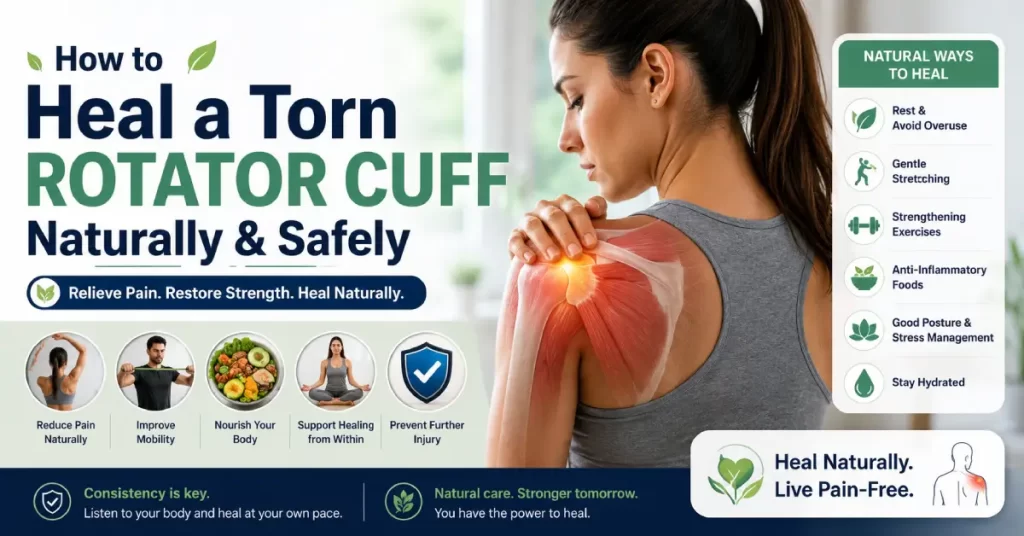
How to Heal a Torn Rotator Cuff Naturally
Introduction
You reach for a shelf, or maybe just try to brush your hair, and something in your shoulder catches. That’s usually how this starts. If you’re now searching for how to heal a torn rotator cuff naturally, you’re probably somewhere between “this will pass” and quietly worried it won’t. Fair enough — the shoulder is one of those joints nobody thinks about until it stops cooperating.
Here’s the part most people skip past too fast: natural healing isn’t the torn fibers stitching themselves back together while you sleep. It’s closer to retraining the whole shoulder — muscles, movement patterns, daily habits — around an injury that may never fully “close.” Different goal, but a workable one, and that’s what this guide is actually about.
Does a Torn Rotator Cuff Really Heal on Its Own?
Short answer: not in the way most people picture it. Tendon doesn’t have the blood supply that skin has, so a torn rotator cuff generally won’t knit itself back to its original shape no matter how much rest you throw at it. That’s just the biology, and no amount of patience changes it.
What actually tends to happen is more interesting, though. Nearby muscles start compensating. Inflammation calms down. Pain fades out over weeks. And somewhere in there, function comes back — even with the tear technically still present on a scan. Plenty of people live full, pain-free lives with a rotator cuff that never “healed” in the strict sense.
Why This Matters for Your Recovery Plan
If you’re aiming for the tear to vanish, you’ll probably end up frustrated. Aim instead for strength, range of motion, and pain control, and the numbers look a lot better. It’s a small mental shift, but it changes how you approach every week of recovery after this point.
What Type of Rotator Cuff Tear Do You Actually Have?
You can’t really plan a recovery around a guess. A minor strain and a full-thickness tear feel oddly alike in the first week or two — same dull ache, same trouble sleeping on that side. Rotator cuff tear symptoms like night pain, sudden weakness, or a catching feeling when you lift your arm can point to either one. That’s exactly why this step matters more than people give it credit for.
| Tear Type | Typical Approach | Realistic Timeline |
|---|---|---|
| Mild strain or partial tear | Rest, physical therapy, home exercises | 6 weeks to 6 months |
| Moderate partial tear | Structured PT, activity changes | 3 to 6 months |
| Full-thickness tear | Often needs surgical evaluation | Varies, longer with surgery |
| Tear with major weakness or loss of arm lift | Needs prompt medical evaluation | Depends on findings |
Step-by-Step Guide: Getting a Proper Diagnosis
- See a doctor or an orthopedic specialist instead of relying on internet symptom checkers.
- Get a hands-on physical exam that checks your shoulder’s strength and range of motion.
- Ask about imaging, usually an MRI or ultrasound, if a tear seems likely.
- Find out clearly whether you have a partial or a full-thickness tear.
- Ask your doctor directly whether non-surgical management is realistic for your case.
People skip this step constantly, and it costs them. Treating every shoulder ache the same way — ice it, rest it, hope for the best — can burn through months before anyone finds out it was a moderate tear that actually needed a real plan.
How to Heal a Torn Rotator Cuff Naturally: The Core Approach
Once a doctor gives the green light for non-surgical treatment, the actual work starts — and it’s less dramatic than people expect. No miracle stretch, no single magic day. Just showing up for it, consistently, over weeks.
Step-by-Step Guide: Non-Surgical Recovery Method
- Rest the shoulder for the first 3-5 days — no reaching overhead, no gripping anything heavy.
- Ice it for the first 48 to 72 hours, roughly 15-20 minutes at a stretch, then switch to heat once the sharp stage passes.
- Start gentle range-of-motion movements once the acute pain eases, ideally guided by a physical therapist.
- Move into strengthening work for the rotator cuff and the muscles around it as things improve — usually a couple weeks in, not day one.
- Adjust the daily habits that keep aggravating it — the way you reach into a cupboard, how you sleep, that kind of thing.
- Check in with your doctor or therapist every few weeks so someone’s actually tracking progress, not just your gut feeling about it.
Why Physical Therapy Carries Most of the Weight
It’s easy to write physical therapy off as “just stretching,” but a decent program is more targeted than that. It goes after the specific muscles propping up the injured tendon, taking the load off it while quietly building strength underneath. People combining rest with active physical therapy for shoulder injuries tend to come out ahead of those who just wait it out — not always, but often enough that it’s worth the effort.
Best Exercises for a Torn Rotator Cuff
People underrate movement in this whole process, probably because “rest it” is the advice everyone’s heard their whole life. But learning how to heal a torn rotator cuff naturally leans heavily on the right kind of motion, done at the right pace — not grinding through pain, just steady, boring repetition.
Method: Starter Exercise Routine
- Pendulum swings — lean forward, let your arm hang loose, and swing it gently in small circles, maybe 10-15 per direction.
- Wall slides — facing a wall, slide your hand up slowly while keeping contact, working your range of motion a little further each session.
- Isometric holds — press your arm against a wall or doorframe without moving it, holding 5-10 seconds, building strength without any actual joint movement.
- External rotation with a resistance band — elbow tucked at your side, rotate your forearm outward slowly, 2-3 sets of 10 once it’s tolerable.
- Scapular squeezes — pull your shoulder blades together like you’re pinching a pencil between them, hold a few seconds, release.
Go slower than feels necessary — most people rush this part. If any of these rotator cuff exercises produce sharp pain rather than a mild pull, stop. That’s not weakness, that’s the shoulder telling you something useful.
Can Diet and Supplements Help a Rotator Cuff Tear?
This is usually where “natural healing” articles overpromise, so let’s not do that here. Eating in a way that lowers general inflammation can help — a little less soreness, a bit less strain on an already irritated joint — especially when it’s paired with actual movement, not instead of it.
Anti-inflammatory foods — think fatty fish, leafy greens, turmeric, ginger — can take the edge off inflammation in the body generally. They will not regrow a torn tendon. That’s just not what they do, no matter how religiously you eat them. If you’re considering supplements on top of your diet, run it by your doctor first, especially if you’re already taking other medication.
What About Newer Regenerative Options?
PRP injections and stem cell therapy come up a lot in this space, often marketed with a lot more confidence than the research currently backs. A PRP injection uses platelets pulled from your own blood to try to nudge healing along at the injury site, and early results for smaller tears look encouraging. Still developing science, though — worth discussing with a sports medicine specialist, not deciding based on a targeted ad.
Daily Habits That Genuinely Support Recovery
None of this is glamorous, but the boring, repeated stuff is usually what moves the needle over months, not the occasional big effort.
- Sleep on your back or on the uninjured side — side-sleeping on the bad shoulder undoes a lot of daytime progress.
- Skip the overhead lifting and the heavy grocery bags on that arm for now.
- Actually do the prescribed exercises on schedule, not just on days you remember.
- If your doctor’s fine with it, over-the-counter anti-inflammatories can help take the edge off.
- Accept that this takes weeks to months. Discipline speeds up progress, it doesn’t skip the timeline.
A shoulder that gets steady, moderate attention tends to do better than one bouncing between total rest and sudden overuse — the stop-start pattern seems to slow things down more than either extreme alone.
Is Shoulder Impingement the Same Thing as a Rotator Cuff Tear?
Related, not identical. Shoulder impingement is when the tendon gets pinched during certain movements, and left alone long enough, it can actually progress into a tear. A physical exam usually separates the two pretty quickly, so it’s not a hard mystery to solve if you get checked.
Could It Actually Be Frozen Shoulder Instead?
Frozen shoulder shows up as stiffness and a real loss of range, which can look a lot like a tear at first glance. The tell is usually strength — frozen shoulder doesn’t cause the same weakness a tear does, and it tends to creep in more slowly. Worth ruling out early, since the treatment approach is genuinely different.
When Natural Healing Genuinely Isn’t Enough
Even with real effort and consistency, some tears do need surgical repair. These are the warning signs worth taking seriously instead of pushing through on hope alone.
- Weakness that hasn’t budged after 6-8 weeks of consistent therapy
- Can’t lift your arm past shoulder height, even on a good day
- A large or full-thickness tear confirmed on MRI or ultrasound
- Pain that’s climbing week over week instead of settling
- The tear came from a fall or sudden yank, not gradual wear
Complete Steps: Understanding the Surgical Recovery Path
- Your surgeon reviews your imaging and discusses whether arthroscopic or open repair suits your case.
- Pre-surgical physical therapy often comes first, strengthening the shoulder beforehand.
- Recovery typically means a sling for several weeks, followed by gradual rehab.
- Full strength and function often take several months to come back.
- Post-surgical shoulder rehabilitation isn’t optional — skip it and even a clean repair won’t feel like one.
Rotator cuff surgery recovery timelines swing a lot depending on tear size, age, and honestly how disciplined someone is about their rehab afterward. Rushing this part is a common way to end up with a “successful” surgery that still feels weak a year later.
Where People Usually Go Wrong
The same handful of mistakes show up again and again, across pretty different people. Worth knowing them in advance rather than learning the hard way.
- Guessing at the tear type instead of getting it properly diagnosed
- Treating sharp pain as something to grind through rather than a warning sign
- Relying on supplements alone, while the actual rotator cuff strengthening work gets skipped
- Quitting exercises the moment pain fades — before the strength underneath has actually caught up
- Putting off the doctor’s visit for weeks after things clearly got worse
Can You Fully Recover Without Surgery?
For a lot of partial tears, yes. A non-surgical treatment approach can get you to a functional, mostly pain-free shoulder within a few months. It really comes down to tear size, age, activity level, and — more than anything — whether you actually stick with rehab instead of treating it as optional.
FAQs About Healing a Torn Rotator Cuff Naturally
Can a partial rotator cuff tear heal completely on its own?
Not in the sense of the tissue fully regenerating — that part’s unlikely. But plenty of partial tears respond well enough to rest and physical therapy that people get back to normal function anyway, no surgery needed.
How long does natural rotator cuff healing typically take?
Somewhere between six weeks and six months for most partial tears, assuming you’re actually doing the physical therapy consistently. Leave a full-thickness tear untreated, though, and it can drag on much longer without ever really improving on its own.
Is it safe to keep exercising with a torn rotator cuff?
Generally, yes, as long as it’s gentle and matched to your specific tear. This isn’t a “push through it” situation — a physical therapist can tell you which movements help and which ones just make things worse.
Do turmeric and other supplements actually help rotator cuff tears?
They might take the edge off general inflammation. They won’t regenerate torn tendon fibers, and there’s no solid research suggesting otherwise. Best used as a supporting piece next to physical therapy, not instead of it.
How do I know if I need surgery instead of natural treatment?
Weakness that isn’t budging, trouble getting your arm above shoulder height, or a large full-thickness tear on imaging — any of those point toward surgery being worth discussing. Your doctor can confirm it properly after an actual evaluation.
Can a torn rotator cuff get worse if I don’t treat it?
It can, and fairly often does. Tears tend to enlarge with continued use if there’s no rest or proper rehab involved, which is really the whole argument for getting diagnosed early instead of waiting it out.
Is physical therapy really necessary, or can I just rest?
Rest alone almost never rebuilds the strength you need back. The muscle weakness that lingers after a tear needs targeted work — that’s specifically what structured physical therapy is built to address.
What’s the biggest mistake people make trying to heal naturally?
Skipping the diagnosis step and treating every shoulder ache the same. A minor strain and a full-thickness tear call for genuinely different approaches, and guessing wrong just costs you time you didn’t need to lose.
Where That Leaves You
Strip away the marketing language, and how to heal a torn rotator cuff naturally really comes down to three things: an honest diagnosis, consistent movement, and realistic expectations about time. Not the tear vanishing — just your shoulder doing what you actually need it to do again.
Rest matters. The right exercises matter more. And patience carries a surprising amount of the load, especially with partial tears caught early and taken seriously from day one. Rushing or skipping steps tends to backfire, even when the intention behind it is good.
If your shoulder still isn’t cooperating, or you’re not sure what you’re even dealing with, talk to a doctor or a physical therapist before trying to sort it out alone. One short appointment now can save you months of guessing later.


