Dental Veneers For Missing Teeth: What Actually Works Best
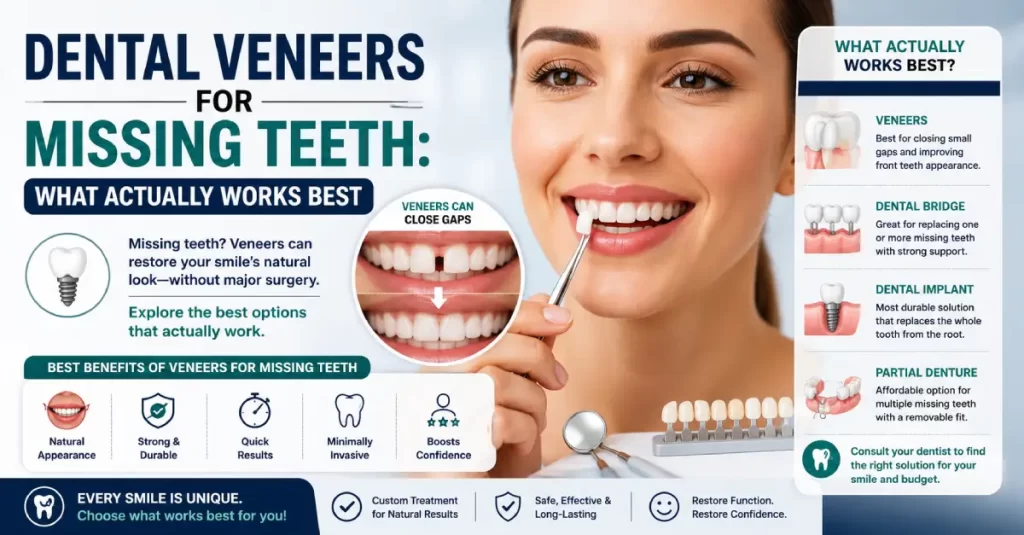
dental veneers for missing teeth
Dental Veneers For Missing Teeth: What Actually Works Best
You’ve got a gap where a tooth used to be. Somewhere along the way, someone mentioned veneers might fix it — makes sense, the word gets thrown around constantly, usually attached to those bright, perfect celebrity smiles. But here’s the thing worth knowing before you go any further: dental veneers for missing teeth isn’t really how veneers work. They’re not built to fill an actual gap. Not even close, honestly.
That’s not the end of the story, though. Once you get what veneers actually do, it’s a lot easier to land on what will actually fix a missing tooth — and there are a few solid options, each with its own trade-offs. Let’s just walk through it. No jargon, no sales pitch.
What Are Dental Veneers, Really?
Veneers are thin shells — porcelain usually, sometimes a resin composite — bonded onto the front surface of a tooth that’s still there. Picture a thin custom-fitted cover. It changes how the tooth looks — color, shape, small gaps — without replacing what’s underneath.
Dentists reach for veneers mostly for cosmetic reasons. Chipped edges. Stains that won’t budge with whitening. Teeth a bit too small or oddly shaped. What veneers absolutely need, though, is a tooth root and structure to bond onto. No tooth, no anchor point. And that’s exactly why veneers can’t solve a missing tooth on their own — there’s just nothing there to stick to.
Why Veneers Don’t Work for a Missing Tooth
This trips a lot of people up. Easy mistake to make, really. A veneer is basically a facade — thin, stuck to the front of an existing tooth. Take the tooth away and there’s nothing left to attach to. No foundation. No support. Nowhere for it to go.
Some clinics do offer something called a “Maryland bridge,” or a “veneer bridge” — kind of borrows the idea. A false tooth held in place by wings bonded to the teeth on either side of the gap. Worth knowing about, for sure, but it’s a different product entirely from a standard veneer, and it’s got its own pros and cons we’ll get to.
What Actually Replaces a Missing Tooth?
Okay, here’s where it gets useful. If a tooth’s truly gone — root and all — there are three main routes people usually go with, and each one solves the problem a different way.
Dental Implants
A titanium post goes into the jawbone. Once it heals and fuses — osseointegration, that’s the technical word for it — a crown gets attached on top. Closest thing to a real tooth you’ll get. Looks natural, chews normally, doesn’t lean on neighboring teeth for support at all.
Dental Bridges
A bridge fills the gap with a false tooth anchored by crowns on the teeth either side. Faster than an implant, often cheaper upfront too, though it does mean shaving down two healthy teeth to make room for those anchor crowns. Bit of a trade-off there.
Partial Dentures
A removable appliance that clips onto your remaining teeth, holding a false tooth — or a few — in the gap. Least invasive of the bunch, usually the most affordable too, though it takes some getting used to and needs to come out every night for cleaning.
Comparing Your Options for a Missing Tooth
Here’s a side-by-side, since seeing it laid out tends to make the decision way less overwhelming.
| Option | Looks Natural | Durability | Affects Nearby Teeth | Average Lifespan |
|---|---|---|---|---|
| Dental Implant | Very natural | Excellent, long-term | No | 15–25+ years |
| Dental Bridge | Fairly natural | Good | Yes, requires shaving | 10–15 years |
| Partial Denture | Decent | Moderate | Minimal (clasps only) | 5–8 years |
| Maryland/Veneer Bridge | Natural for front teeth | Fair | Minimal bonding only | 5–10 years |
How to Decide Which Missing Tooth Solution Is Right for You?
Not a one-size-fits-all decision. Shouldn’t be rushed either. A few things tend to matter more than people expect going in.
Step-by-Step Guide
- Get a proper dental exam first. Your dentist checks jawbone density, gum health, and the state of the nearby teeth — this alone rules things in or out fast.
- Think about your budget, realistically. Implants cost more upfront but often save money over decades, since they last so much longer than the alternatives.
- Consider how many teeth are missing. One gap opens up more choices. Several missing in a row might steer you toward a bridge or a partial instead.
- Ask about your bone health. Implants need enough jawbone to anchor into. Bone loss might mean a graft first, or a different route entirely.
- Factor in healing time. Implants take months to fully integrate. A bridge or denture, weeks.
- Talk maintenance honestly with your dentist. Dentures need nightly removal and cleaning. Bridges and implants get brushed and flossed like normal teeth, just a bit more careful around the edges.
- Get a second opinion if you’re on the fence. Different dentists lean different ways sometimes — another set of eyes rarely hurts.
A mistake a lot of beginners make is going with whatever’s cheapest upfront, without really thinking through the years ahead. A partial denture saves money now but often needs replacing sooner than an implant would.
Can a Maryland Bridge Work Like Veneers for a Missing Front Tooth?
Sort of, yeah — at least in spirit. A Maryland bridge uses thin metal or porcelain wings bonded to the back of the teeth next to the gap, holding a false tooth in place. No drilling into healthy teeth needed, which is the whole appeal. Works best for a single missing front tooth, where the bite force is lighter than what happens further back.
The trade-off’s durability. That bonding can weaken over time, especially if you bite into something hard, and it’s not usually recommended for back teeth doing the heavy chewing. Still — for a front gap, it’s a genuinely less invasive middle ground between a full bridge and an implant.
What Happens If You Leave a Missing Tooth Untreated?
Tempting to just leave the gap alone, especially if it’s not visible or doesn’t hurt. But a missing tooth doesn’t just sit there quietly. Nearby teeth tend to drift into the space over time, which can throw off your bite entirely. The jawbone underneath can shrink too, gradually, since there’s no tooth root left stimulating it — dentists call that bone resorption.
There’s a knock-on effect as well. A shifted bite can lead to jaw pain down the line, and gum health around the gap often suffers since it’s harder to clean properly. None of this happens overnight. But the longer a gap sits there untreated, the more complicated — and pricier — fixing it tends to get.
How Much Do Missing Tooth Treatments Cost?
Costs swing a lot depending on location, the dentist, how complex your case is. Still, here’s a rough sense of where things typically land.
- Dental implants: Usually the most expensive upfront — surgical placement plus the crown — but tend to be the most cost-effective over a couple of decades.
- Dental bridges: Mid-range, generally less than implants but more than dentures, with the catch of needing replacement roughly every decade or so.
- Partial dentures: The most budget-friendly to start, though they typically need adjusting or replacing more often than the others.
- Maryland bridges: Comparable to, or slightly less than, a traditional bridge, since less structural work’s involved.
Insurance coverage varies a fair bit too — worth checking with your provider before assuming any option’s out of reach.
Complete Steps to Prepare for a Missing Tooth Replacement Procedure
Whichever route you land on, a bit of prep beforehand tends to make the whole thing smoother, and the results better too.
- Book a consultation and full exam. X-rays, a look at gum health, a real conversation about your goals — all before anything gets decided.
- Ask every question you’ve got. Recovery time, expected lifespan, what happens if something goes wrong. Get it all on the table early, don’t hold back.
- Sort out the financial side. Confirm what insurance covers, ask about payment plans if the cost feels like a stretch.
- Treat any existing gum disease first. Healthy gums matter a lot for how well an implant or bridge ends up holding long-term.
- Plan around the timeline. Going the implant route means factoring in months of healing before the final crown goes on.
- Arrange for aftercare support. Especially with implant surgery — a ride home, some soft food stocked up, makes recovery day a lot easier.
Is It Better to Get an Implant or a Bridge for One Missing Tooth?
Depends what you’re prioritizing, honestly. Want something that’ll last decades and doesn’t touch the neighboring teeth at all? Implant usually wins. Rather skip oral surgery, or working with a tighter budget and timeline? A bridge gets it done faster — even though it means altering two healthy teeth along the way.
From what tends to come up in dental consultations, patients who go the implant route often end up happier long-term, mainly because it feels and functions closest to a real tooth. That said, a bridge isn’t a bad call either — solid, well-established, worked for people for decades now.
Frequently Asked Questions
Can veneers replace a missing tooth completely?
No, not on their own. Standard veneers bond to an existing tooth’s surface and need that tooth structure to work at all. For a fully missing tooth, implants, bridges, or a Maryland bridge are the real options worth looking at.
What is a Maryland bridge and how is it different from a veneer?
A Maryland bridge is a false tooth held in place by thin wings bonded to the teeth on either side of a gap. Unlike a standard veneer, which covers a tooth that’s already there, this one’s built specifically to fill a missing space.
How long does a dental implant last?
With decent care, a dental implant can last 15 to 25 years, sometimes longer — one of the most durable options out there. The crown on top might eventually need replacing, but the implant post itself often lasts a lifetime.
Is getting a dental implant painful?
Most people report mild discomfort more than sharp pain, usually handled with over-the-counter relief for a few days. The procedure itself happens under local anesthesia, so you shouldn’t feel much during the actual placement.
Can I get veneers on the teeth next to a missing tooth?
Yes, actually pretty common — especially if those teeth show wear from shifting or extra bite pressure. Veneers can improve how they look on their own, though they won’t fill the gap where the tooth’s actually missing.
Do dental bridges damage the teeth next to the gap?
There’s some trade-off, yeah. The teeth on either side get filed down to hold the crowns supporting the bridge, and that removes healthy enamel permanently — no getting around that part.
Are partial dentures a good long-term solution?
They can work fine for some people, especially as a more affordable route, though they generally don’t last as long as implants or bridges. A lot of people use dentures as a stopgap before eventually moving to something more permanent.
What’s the cheapest option for replacing a missing tooth?
Partial dentures, typically, are the most affordable upfront — though they usually need more frequent adjustments and replacements down the line. Worth weighing that lower initial cost against the long-term expenses before deciding.
Final Thoughts
If there’s one thing worth taking from all this, it’s that dental veneers for missing teeth is a bit of a misconception — veneers cover teeth that are already there, they don’t replace ones that are gone. But that doesn’t leave you stuck, not by a long shot. Implants, bridges, partial dentures, Maryland bridges — they all genuinely solve the problem, each one suited to a different budget, timeline, and long-term goal.
Picking the right one really comes down to your specific situation. How many teeth are missing. Your jawbone health. What you’re comfortable with, cost and upkeep-wise. There’s no universal “best” here — just the one that actually fits your mouth and your life.
So if you’re dealing with a missing tooth right now, don’t put off that conversation with your dentist. Book the consultation, ask the questions that actually matter to you, and walk out with a plan built around your mouth — not some generic answer pulled off the internet.


